

Threadless and Internally Threaded Jewelry: Why Professional Studios Need Both
Published on 18th September 2026
In professional piercing, jewelry selection is not only about aesthetics: it directly affects insertion precision, tissue trauma, healing performance, and long-term client comfort. Among the most widely used attachment systems today, threadless and internally threaded jewelry have become the industry standards for high-quality body jewelry.
While both options are considered significantly safer and more professional than externally threaded jewelry, they are designed around different mechanics and workflows. Understanding the differences between them allows studios to optimize procedures, improve client experience, and select the most appropriate mechanism for each piercing application.
At Acha Direct, we have been monitoring the evolution of the market, and we can attest to the evident shift towards safety and quality, tilting the preferences to internally threaded jewelry and, more recently, threadless piercings. We believe jewelry systems should be evaluated not only from a design perspective but also through the lens of clinical performance, consistency, and procedural efficiency. That is why we offer a strong and versatile catalogue of both threadless and internally threaded jewelry, allowing professional studios to work with the system that best fits each placement, technique, and client need. Threadless jewelry offers speed and flexibility, allowing new options for visibility and accommodating the jewelry, for instance, in forward-facing body jewelry, while internally threaded jewelry provides secure attachment and stability. Rather than seeing them as competing systems, we see them as complementary solutions that every professional studio should have available.
This guide breaks down the key differences between threadless and internally threaded jewelry, including their advantages, limitations, and ideal professional use cases.
What Is Threadless Jewelry?
Most threadless jewelry uses a natural tension-based mechanism that works as an internal lock rather than traditional screw threading. The decorative end contains a slightly bent pin that is inserted into a hollow post, creating tension that securely holds the piece in place. Instead of twisting or screwing components together, the jewelry locks through pressure and flexibility. You can see our explanation of how to properly insert threadless jewelry in the following image.

Another threadless mechanism is a shorter straight pin that has a thinner rim near the top, which locks with the post and keeps it in place, as you can see in the image below of one of our jewels. This version is less common, but it offers more security by holding both pieces of jewelry together. For this reason, this is the best choice for expensive jewelry such as nickel-free gold (18kt, 14kt, etc.) and 925 sterling silver. We call this “threadless push-in” versus the previous one, called “push pin”.

Threadless jewelry has become increasingly popular in modern studios due to its speed, versatility, and ease of use. More importantly, it offers the possibility to point the jewelry in a certain direction, which is very convenient for products that need to be shown in a specific way, with the face straight or to one side. This widens the options, especially for bananas and circular barbells, as well as forward-facing jewelry. When properly adjusted, threadless jewelry offers a secure fit while remaining quick and easy to remove when needed. Besides, decorative ends can be changed rapidly, making them especially practical for curated ear styling, jewelry upgrades, and clients who frequently switch designs. Threadless jewelry is also appreciated for improving workflow efficiency during procedures. Since there is no threading involved, installation and removal are generally faster and require less repetitive manipulation.
What Is Internally Threaded Jewelry?
Internally threaded jewelry uses a threaded pin attached to the decorative end, which screws into threads located inside the post itself. Unlike externally threaded jewelry, where the threads are exposed on the wearable surface, internally threaded systems keep the exterior of the post smooth. This significantly reduces friction and tissue irritation during insertion, making the jewelry more comfortable and safer for healing piercings.
Internally threaded jewelry has long been considered one of the professional standards in body piercing, particularly for fresh piercings, due to its combination of security, precision, and durability. When properly manufactured, the threaded connection creates a highly stable fit that resists accidental loosening during everyday wear. See how the internally threaded mechanism works, its advantages and the main differences with the externally threaded mechanism in the picture below.

For this reason, many professional piercers continue to prefer internally threaded jewelry for first piercings, high-movement areas, or situations where maximum connection security is important.
Why Both Are Preferred Over Externally Threaded Jewelry
Professional studios generally avoid externally threaded jewelry because external threading can create micro-trauma while passing through tissue, especially in fresh piercings.
Note: A good way to avoid issues when inserting externally threaded jewelry is to use special insertion tapers that cover the threading and guide the jewelry into place without tearing the skin
Both threadless and internally threaded systems offer major advantages:
- Smoother and safer insertion
- Reduced tissue irritation and inflammation
- Better healing conditions for fresh piercings
- Improved comfort during jewelry changes
- Greater connection stability and reliability
- Easier hygiene and upkeep
For these reasons, both systems are widely recognized as professional-grade options within the body piercing industry and are strongly preferred by experienced piercers and organizations such as the Association of Professional Piercers (APP). In the following image, you can get a better look at the mechanisms and how they work.

At Acha Direct, we support best practices and piercing safety as the main pillars of responsible piercing. For this reason, we are increasing our lines of these products in accordance with industry trends, and we offer a wide catalogue of both threadless and internally threaded jewelry. Each mechanism provides important benefits for professional studios: threadless jewelry brings flexibility, fast installation, and easy style changes, while internally threaded jewelry offers secure fastening, strength, and excellent reliability in more demanding placements. By offering both options in professional materials and a wide range of designs, we help studios choose the most suitable option for each piercing, client, and procedure.
Threadless Jewelry: Pros & Cons
Advantages of Threadless Jewelry
- Faster and more convenient jewelry changes: threadless systems allow for quick insertion and removal without repetitive twisting, reducing handling time during procedures. This is especially useful in high-volume studios where workflow efficiency matters.
- Better for frequent styling changes: because decorative ends can be swapped quickly, threadless jewelry is extremely popular for curated ear styling and for clients who frequently change looks.
- Better compatibility within systems: many threadless systems are designed with standardized pin sizes, allowing compatibility between multiple tops and posts. This increases flexibility for both studios and clients.
- Reduced wear on threads: since there are no screw threads involved, there is less long-term risk of thread stripping or mechanical degradation.
Limitations of Threadless Jewelry
- Tension can loosen over time: if the pin tension is not adjusted correctly, tops may loosen with repeated wear or movement. Proper bending and adjustment are essential, so we recommend informing your customers to check from time to time.
- Learning curve for proper tensioning: although simple once mastered, incorrect pin bending can affect retention strength or even break the jewelry. Studios must ensure staff are trained in proper handling techniques.
Internally Threaded Jewelry: Pros & Cons
Advantages of Internally Threaded Jewelry
- Highly secure connection: internally threaded systems create a very stable mechanical lock, making them ideal for situations where maximum security is required.
- Best option for initial piercings: many professional piercers prefer internally threaded jewelry for fresh piercings because of its precision and secure fit, which prevents tissue damage.
- Strong long-term durability: high-quality internal threading maintains reliable performance over long-term wear when manufactured correctly.
- Premium perception: internally threaded jewelry is often associated with high-end professional jewelry standards and precision manufacturing.
Limitations of Internally Threaded Jewelry
- Slower jewelry changes: screw-based systems typically require more time during installation and removal.
- Thread wear over time: repeated opening and closing can eventually wear down threads if the jewelry is poorly manufactured or over-tightened.
- Small components require precision handling: tiny threaded ends may be more difficult to manipulate, particularly while wearing gloves.
- Higher price: this type of jewelry is usually more expensive than externally threaded.
Threadless vs Internally Threaded: Which Is Better?
The reality is that neither system is universally “better.” Both threadless and internally threaded jewelry are considered professional-grade options, and each offers specific advantages depending on the situation.
The ideal choice often depends on factors such as the type of piercing being performed, the studio’s workflow, the client’s lifestyle, and how frequently the jewelry will be changed. Some piercers prioritize the speed and versatility of threadless systems, while others prefer the added mechanical security of internally threaded jewelry for certain procedures.
For this reason, many professional studios use both mechanisms side by side, selecting the most appropriate option based on the practical and clinical needs of each piercing.

Best Use Cases for Threadless Jewelry
Threadless jewelry is especially effective for:
- Curated ear projects
- Fashion-forward clients
- Frequent jewelry changes
- Studios prioritizing speed and versatility
- Lightweight decorative tops
- Ideal for hard-to-reach areas due to quick insertion time
Its flexibility makes it one of the fastest-growing systems in modern body jewelry.
Best Use Cases for Internally Threaded Jewelry
Internally threaded jewelry is often preferred for:
- Initial piercings
- High-movement areas
- Long-term wear
- Situations requiring maximum connection security
- Heavier decorative ends
Its stability and precision continue to make it a trusted professional standard.
The Importance of Implant-Grade Materials
The performance and safety of any jewelry system do not depend solely on the attachment mechanism; they also rely heavily on the quality and biocompatibility of the materials used.
Even the most advanced threadless or internally threaded design can lead to irritation, delayed healing, or allergic reactions if manufactured with low-quality or non-compliant materials. For this reason, professional-grade body jewelry should always be produced using certified implant-grade materials that meet recognized international standards.
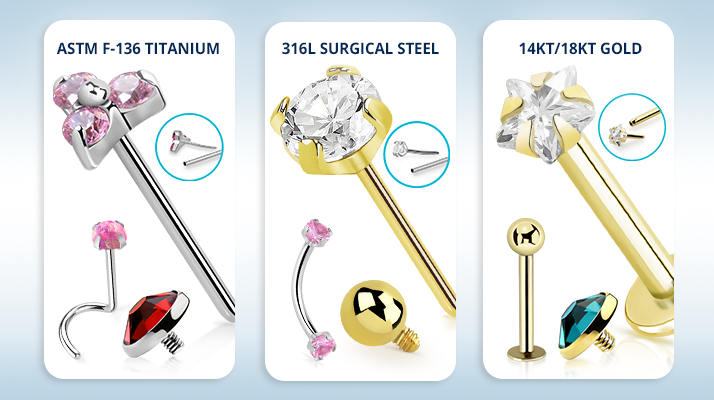
Among the most trusted materials in professional piercing are:
- ASTM F-136 Titanium: widely considered the best standard for initial piercings due to its exceptional biocompatibility, corrosion resistance, and lightweight properties.
- 316L Surgical Steel: commonly used in professional jewelry when manufactured to proper medical-grade specifications.
- 14kt or 18kt Gold: valued for both aesthetics and biocompatibility when it is nickel-free, cadmium-free, and correctly alloyed.
Material compliance plays a direct role in healing times and performance, tissue compatibility, and long-term wear safety. High-quality implant-grade materials reduce the risk of infection, irritation, hypersensitivity reactions, and surface degradation over time.
At Acha Direct, we provide you with professional-grade materials, always prioritizing quality, consistency, and compliance with industry standards. We believe that reliable body jewelry starts with certified materials and precision manufacturing, which is why we place strong emphasis on quality control throughout the entire process to help you offer safer, high-performance jewelry to your clients. You can see our material certificates and testing documentation here.
To Sum Up: What Studios Should Check Before Ordering Threadless or Internally Threaded Jewelry
Before ordering, studios should look beyond the attachment mechanism and consider how the jewelry will work within their existing inventory and procedures.
- Material specifications: Check the exact material grade and available certification, particularly for jewelry intended for fresh piercings.
- Component compatibility: Confirm that tops, posts, gauges, and threading or pin systems are designed to work together. Compatibility should never be assumed between different systems or manufacturers.
- Available dimensions: Review gauges, post lengths, and top sizes to ensure you can accommodate different anatomies and placements.
- Replacement ends: Having tops and other components available separately makes it easier to replace, upgrade, or customize jewelry without replacing the complete piece.
- Ordering flexibility & support: Consider whether your supplier allows you to mix sizes and designs, purchase components individually, and provides reliable assistance when you need help selecting compatible products.
At Acha Direct, we make this information easy to access. You can check our material certifications and testing documentation here, review our shipping conditions and delivery options, and contact our team at any time for support with products, compatibility, or ordering.
Final Thoughts
Both threadless and internally threaded jewelry represent major advancements over outdated externally threaded mechanisms, offering safer insertion, improved healing conditions, and a more professional overall experience for both piercers and clients.
While threadless jewelry stands out for its speed, flexibility, and styling versatility, internally threaded jewelry continues to be valued for its exceptional security, precision, and long-term reliability. Rather than competing systems, they are often complementary tools within modern professional studios.
The best studios understand that choosing jewelry is not just about trends; it’s about selecting the right system for the right application while maintaining the highest standards in materials, manufacturing quality, and consistency.
At a professional level, every detail matters:
- The attachment mechanism
- The precision of the machining
- The surface finish
- The implant-grade material used
- The overall quality control behind the product
At Acha Direct, we believe professional jewelry should combine aesthetics, functionality, and reliability. That’s why we focus on certified materials, precision manufacturing, and consistent quality standards designed to support professional studios and safer piercing experiences. You can check both our certifications and our quality control process by clicking on the links.

Frequently Asked Questions
Is threadless jewelry safe for fresh piercings?
Yes. High-quality threadless jewelry made from implant-grade materials is widely used for fresh
piercings in professional studios.
Is internally threaded jewelry better than threadless?
Not necessarily. Both systems are considered professional-grade and serve different use cases.
Why is externally threaded jewelry discouraged?
Because external threads can damage tissue during insertion and increase irritation.
Can threadless jewelry fall out easily?
Not when properly tensioned. Correct pin adjustment is essential for secure retention.
Which system is faster to change?
Threadless jewelry is generally faster and easier for quick jewelry swaps.
What materials are best for professional body jewelry?
Implant-grade titanium (ASTM F-136), high-quality 316L surgical steel, and 18kt-14kt-10kt gold are
among the safest options. You can view our
material certificates and testing documentation here.
Sources
The ideas outlined in this article are supported by professional piercing literature, recognized material standards, and industry best practices. Key references include:
Association of Professional Piercers (APP)
The APP is one of the leading international organizations promoting safety, hygiene, education, and professional standards within the body piercing industry. Its guidelines highlight the importance of using high-quality body jewelry materials, appropriate jewelry designs, and safe piercing practices to reduce unnecessary tissue trauma and support better healing outcomes.
https://safepiercing.orgASTM International
ASTM International develops technical standards used across medical, industrial, and manufacturing sectors. In the context of body jewelry, ASTM standards are especially relevant for implant-grade materials such as ASTM F-136 titanium, helping studios and suppliers distinguish between recognized material specifications and vague marketing terms such as “surgical titanium” or “medical grade.”
https://www.astm.orgISO Standards for Medical Device Materials
ISO standards provide internationally recognized frameworks for material safety, manufacturing consistency, and quality control. Standards related to medical device materials help support transparency, traceability, and reliability in products designed for long-term contact with the body, including high-quality body jewelry.
https://www.iso.orgThe Piercing Bible – Elayne Angel
The Piercing Bible is a widely recognized professional reference within the body piercing community. It covers jewelry selection, piercing techniques, anatomy-specific considerations, healing, aftercare, and best practices for reducing complications and improving client outcomes.
https://www.piercingbible.com/